Redesigning Togo's Government Services Portal
Togolese Government / Agence Togo Digital
UX Designer
Frontend Developer
2023 - 2026
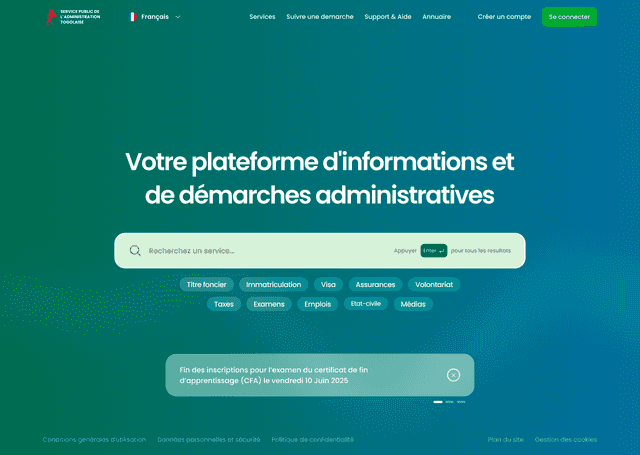
Getting a passport, registering a business, or filing a land title in Togo used to mean navigating a maze of separate offices, each with its own paperwork, queue, and process. Service Public replaces that fragmented, in-person journey with a single digital front door.Service Public is Togo's centralized digital gateway to government services; a single portal replacing the fragmented, in-person administrative journeys citizens and businesses previously had to navigate.Under the promise 'Votre plateforme de services gouvernementaux'', it now gives access to over 300 online services spanning everything from passports to land titles.
Tools
Figma
Visual Studio Code
Programing language and Frameworks
Total.js
Javascript
Html / Css
The Challenge
Government services are inherently sprawling and bureaucratic — hundreds of disconnected procedures, each with its own paperwork, office, and audience. The core UX problem wasn't just visual design, it was information architecture: how do you make hundreds of unrelated administrative services feel like one coherent, navigable system for two very different audiences — everyday citizens and businesses/institutions?
Approach
Services are organized into digestible, card-based domains rather than a flat directory — grouping related procedures (Education & Training, Employment & Social Security, Papers & Citizenship, Taxation/Land/Customs, Health & Social Protection, Justice, Security, etc.) so users can browse by life situation instead of hunting through a bureaucratic index.
The design bifurcates users early into two clear tracks.
Citoyens (B2C)
individuals seeking personal documents, civil status records, employment, health services, etc.
Entreprises / Associations / Professions libérales (B2B)
organizations navigating tax services, land registry, and professional administration.
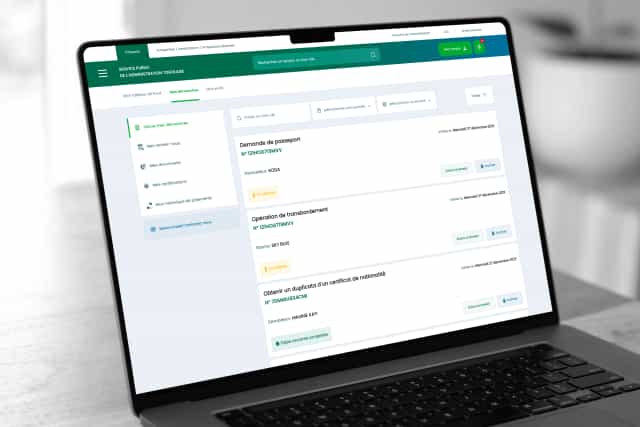
Dashboard view showing citizens' active requests, tracked side-by-side by status.
Impact
What started as a modest rollout quickly became one of the most-used digital touchpoints between citizens and the Togolese state:
2022–2023
+130K
Online service requests fulfilled
+100K
Users registered on the platform
2024
+400K
Online service requests fulfilled — nearly triple the previous period
300+
Active services, covering nearly every category of administrative need
Revamping the experience
After collecting feedback from users, we got the green light from the administration to address the underlying issues. Years of patching the existing platform had built up significant UX debt — so instead of another round of fixes, we went for a full redesign.
Early redesign exploration — carried forward the platform's core visual identity while the underlying structure changed underneath it.
From there, the team moved into a full platform redesign — currently in progress and not yet released — where I worked as UX Designer. This phase involved gathering and analyzing user research feedback, supervising usability testing, reworking the core user flow, designing the UI, and introducing new AI-powered features into the platform.
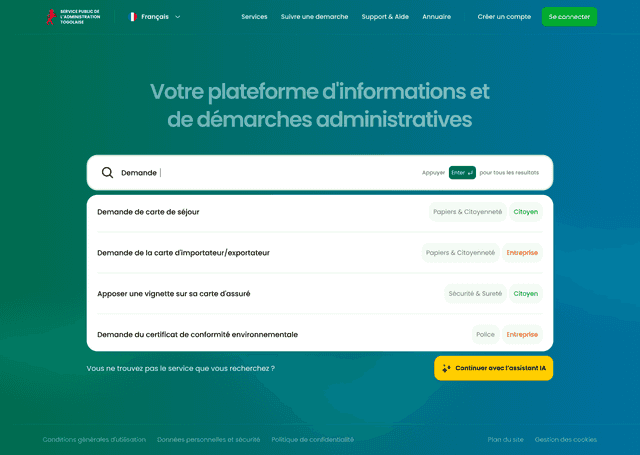
One of the first moves was to remove the global site categorization (Citoyens (B2C) and Entreprises / Associations / Professions libérales (B2B)), which testing showed was confusing for a lot of users — many didn't know which track applied to them before they'd even found their service. In the new version, everything is centralized behind a single search bar.
A single search bar now surfaces services instantly, tagged by category and audience instead of gated behind one.
Introducing AI mode
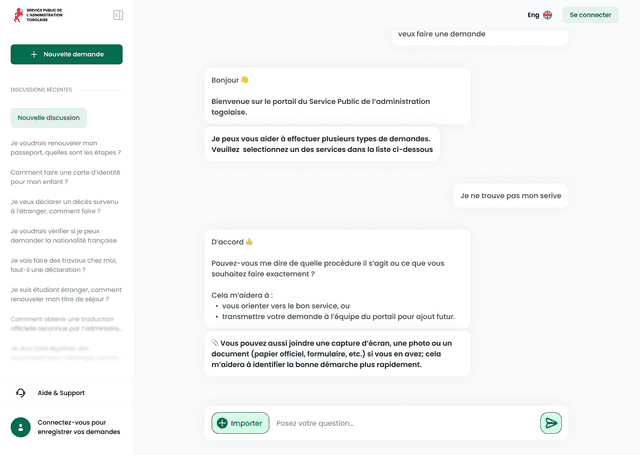
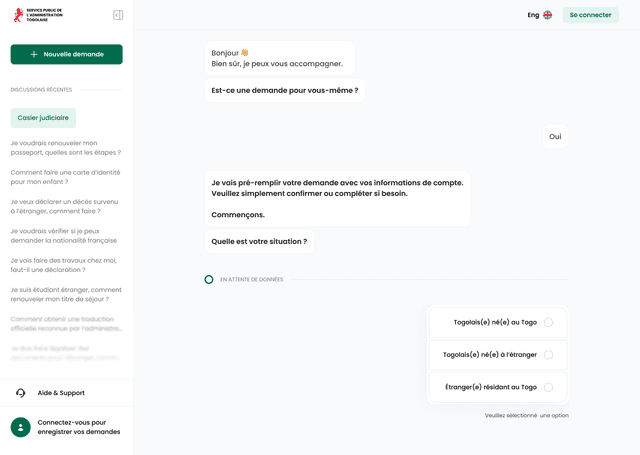
Even with a unified search, some users still couldn't find what they needed — or weren't sure how to phrase it. For them, we introduced AI Mode: a conversational alternative where users can describe what they're trying to do in plain language, get pointed to the right service, and have the AI fill out the form on their behalf using their account data, asking only for what it doesn't already have.
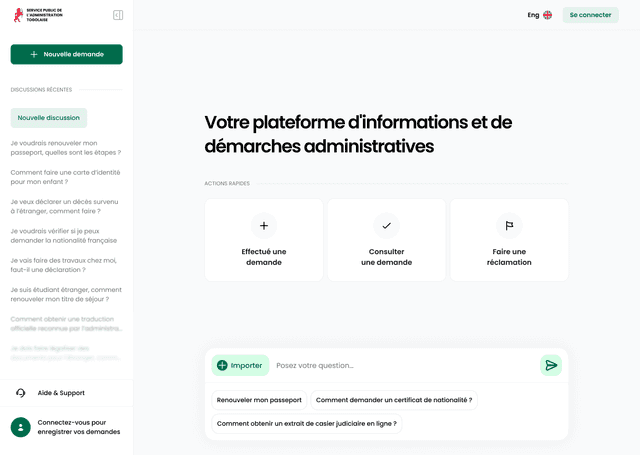
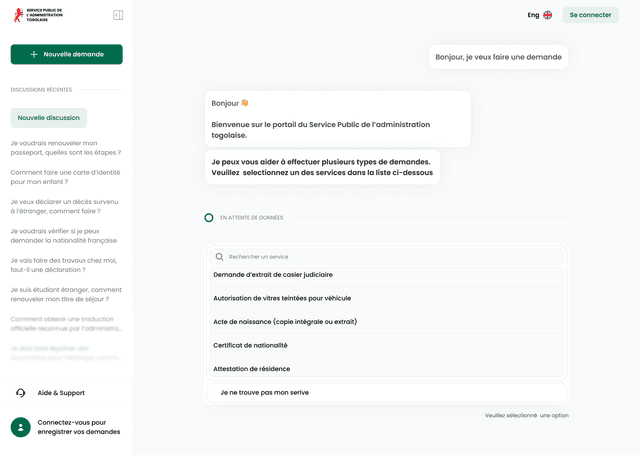
When a request is ambiguous, the assistant surfaces a shortlist of matching services instead of guessing.
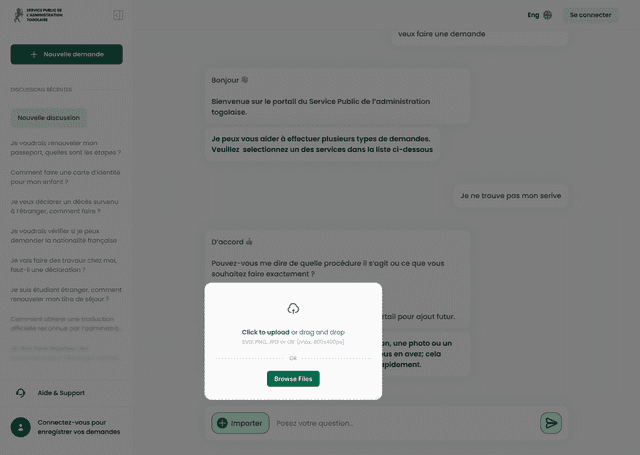
Users can upload a file on request, or on their own initiative — useful when a document is easier to show than describe.
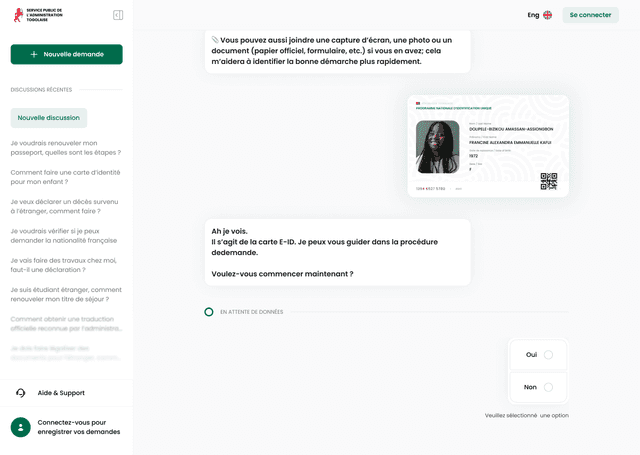
AI responses are either open-ended text or constrained to a set of options, depending on what the step requires.
Introducing spaces
Removing the B2C/B2B split surfaced a new problem: business account management. For recurring services, business owners often didn't have time to manage everything themselves, and handing over full account access to someone else was a real security risk.
On the personal side, we found a parallel issue: many people were handling procedures on behalf of family members who were too young, too old, or simply not comfortable navigating a digital platform — children, siblings, parents.
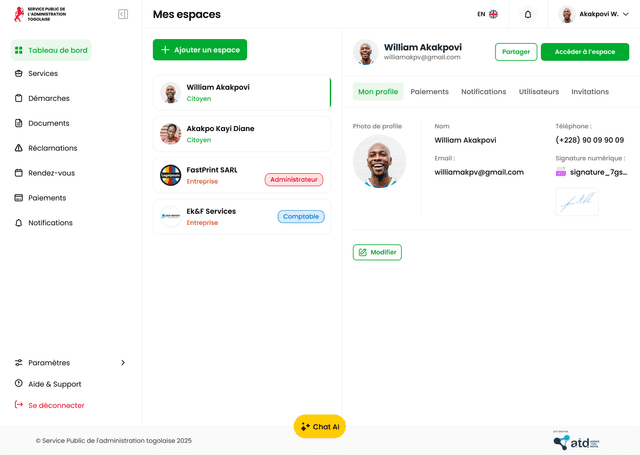
That's why we introduced spaces. A user can create a space linked to their account to manage procedures on someone else's behalf, then hand that space over to them as their own account once they're ready. Anyone can also add an editor to their account for shared, controlled access.
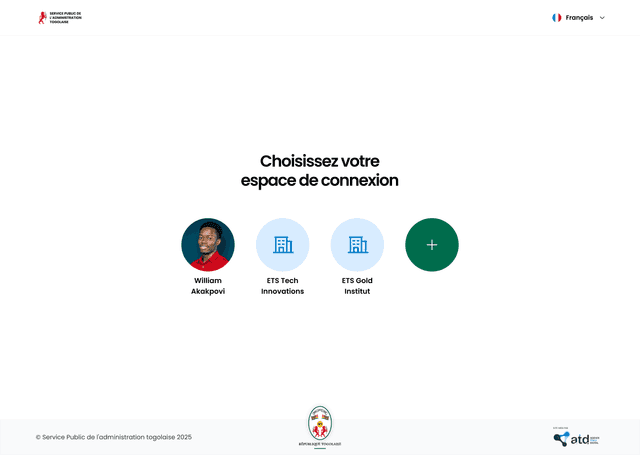
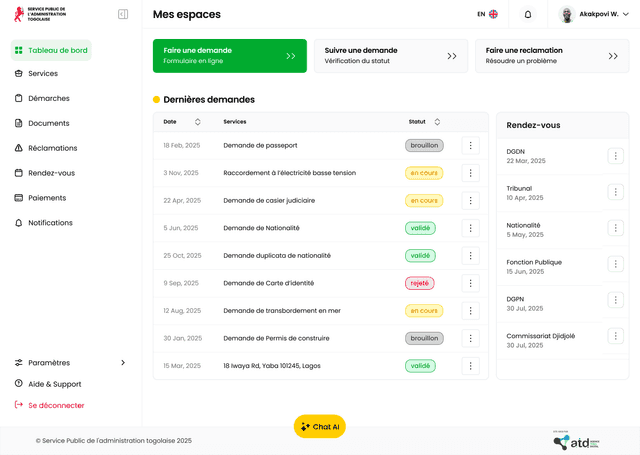
Through the dashboard, a user can manage their own spaces and the ones they're affiliated with. Requests, statuses, and upcoming appointments consolidated in one dashboard.
Where it stands
The redesign is currently in testing ahead of a full rollout. Early usability sessions have been positive, particularly around AI Mode's ability to shortcut users past unfamiliar bureaucratic terminology — the next phase focuses on refining the spaces model for larger organizations with multiple administrators.